





























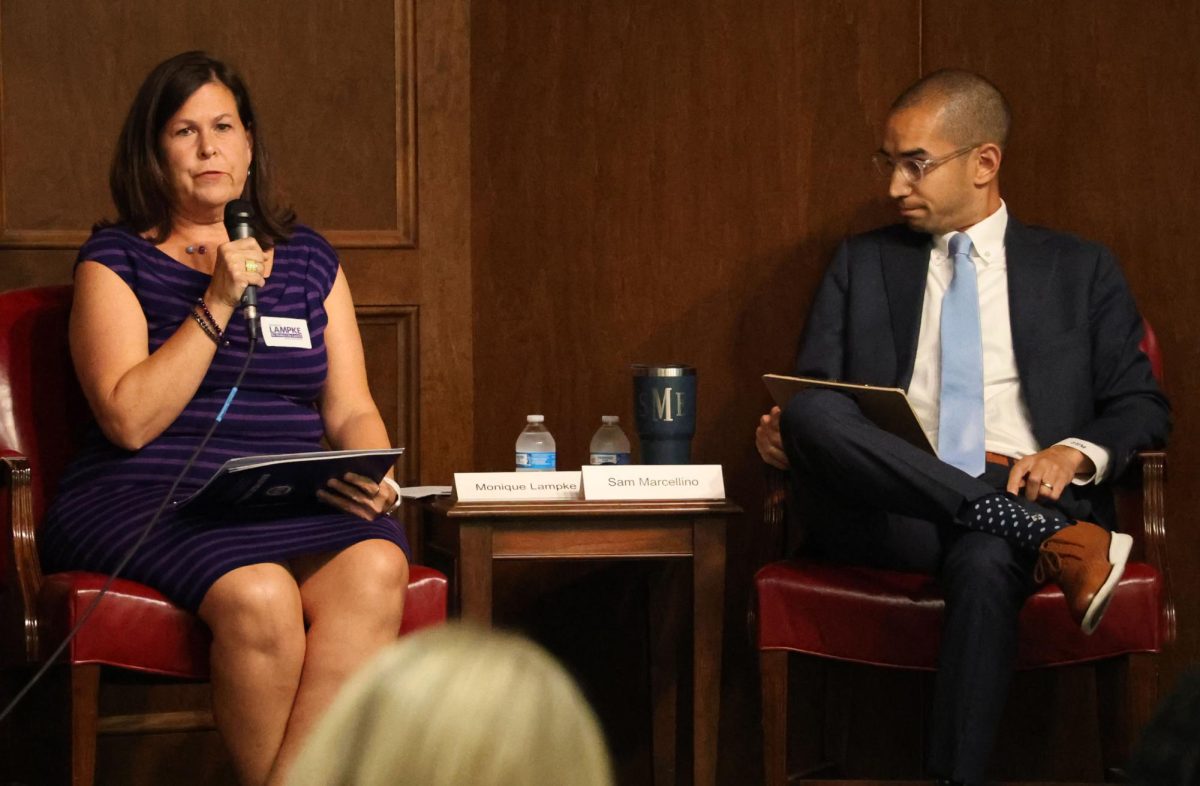
Bexley City Council and Bexley Board of Education candidates answered questions on topics ranging from housing affordability to partisanship at the Bexley Candidates Night, held Tuesday, Sept. 16, at the Bexley Public Library.
The event was hosted by the League of Women Voters, the Bexley Area Chamber of Commerce and the Bexley Public Library and was moderated by State Rep. Dontavius Jarrells and Rick Carfagna of the Ohio Chamber of Commerce.
The event was an open forum, where residents could write questions on notecards which were given to the moderators. Moderators gave each candidate 90 seconds to answer.
Six candidates are running for three City Council seats: Spencer Cahoon, Marybeth Camboni, Gina Fiorino, Monique Lampke, Charlene Bridges and Sam Marcellino, according to the Franklin County Board of Elections. The Bexley Board of Education has three seats up for election as well, according to the Franklin County Board of Elections, and current Board members Jonathan Baker, Patrick King and Joanne Pickrell are running for reelection.
Board of Education candidates were the first group to participate at the event. Some of the most prominent issues discussed were the recent influx of students in Bexley schools and changes in phone policy.
King said he believed the hiring of additional teachers in the middle school will help alleviate challenges faced earlier this year from an influx of students and balance out the teacher to student ratio.
“I think this answers the question about how we’re going to deal with some of the growth, but also is evidence of our ability and willingness to better kids’ educational experiences,” he said.
Baker said the Board was working to address technology usage amongst students both in and outside of the classroom.
“It’s not just so much the technology used during the school day, it’s how they’re doing it even in the evenings,” he added.
During the City Council portion, the panel discussed both the state of Bexley’s infrastructure and housing affordability.
Lampke said she believes public workshops at City Hall, where citizens could recommend different land use strategies, are useful for development projects in Bexley.
Cahoon said expanding housing development is a key factor the Council should consider when it comes to infrastructure. With more people coming into the community, more space is needed, he explained, and there needs to be a spectrum of housing options.
Marcellino said he believes Bexley needs hotels and doctors’ offices to alleviate some stress from residents. He added previous resolutions regarding accessory dwelling units could be useful in mitigating population density issues the city is currently facing.
In Bexley, City Council candidates cannot declare party affiliation on the ballot, Executive Director of the Bexley Chamber of Commerce Bryan Drewry said. However, both Cahoon and Camboni discussed the appeal of a party endorsement.
“It is really hard to be non-partisan in this political climate, and I am seeking the Democratic endorsement,” Camboni said. “I’ve been a Democrat since I was 18, and I’m in my 40s now. It’s something that I firmly believe in.”
Cahoon said he’s received many questions regarding party affiliation while talking with voters, causing him to consider accepting an endorsement.
Other candidates, like Fiorino, said an endorsement is unnecessary.
“It’s not that I don’t find endorsements important on the national stage, but here communication between City Council and Bexley citizens has evolved,” she explained.
Many candidates agreed residents’ voices are crucial to ensuring the Council is able to pass effective and supportive legislation.
Fiorino said the Council should be more accessible to residents.
“I think there should be a strategy in place for how we communicate what and when,” she said. “If we want important input from our residents, that communication should be different.”
Lampke said she tries to keep up with community affairs through police ride-alongs, meeting with seniors or simply talking with neighbors. Input is essential in advocating for residents’ needs, she added.
Bridges said she would strive to be more receptive to constituents’ interests if elected.
“I think we have room for growth in how we accept and how we incorporate feedback from our residents,” she said.
Published and digitized October 2025.
