




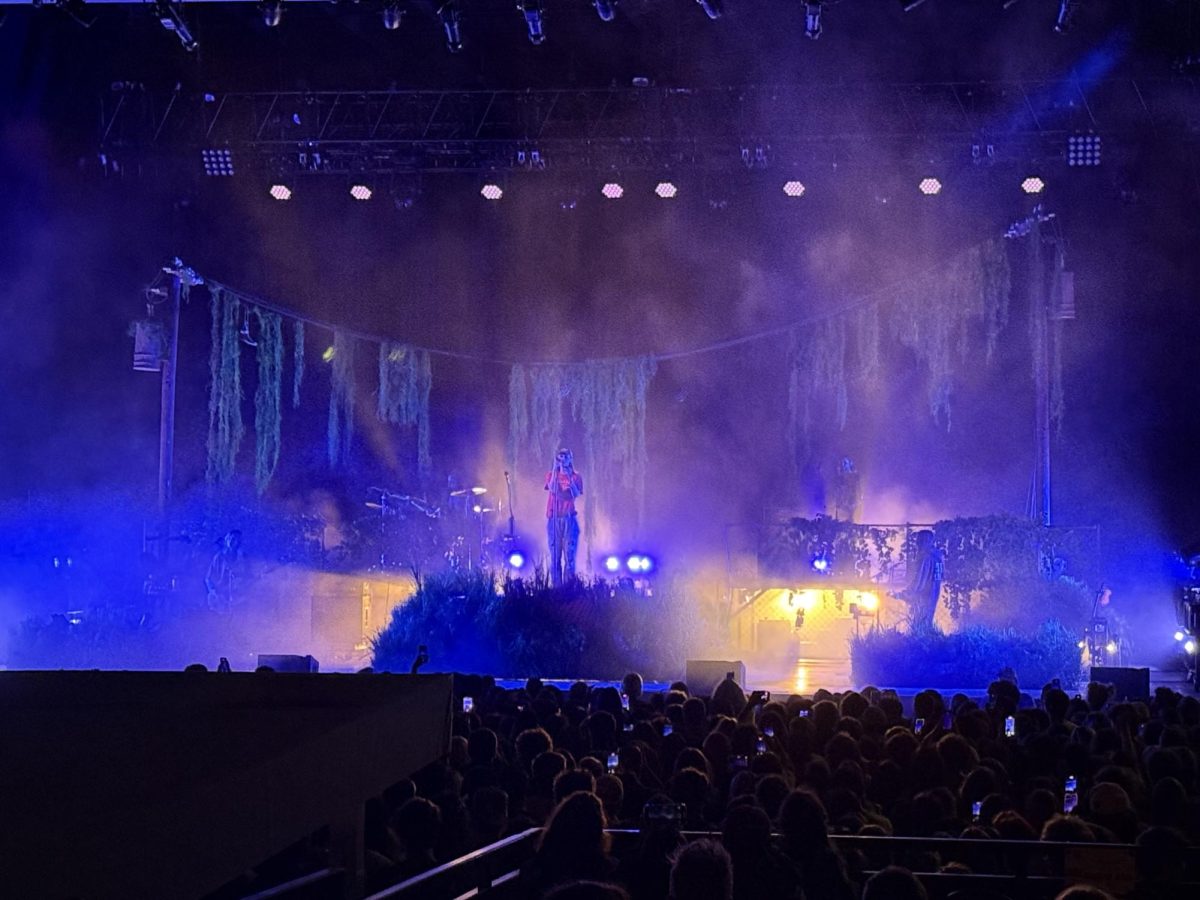





















If Tyler Childers made one thing clear by his July 25 release of “Snipe Hunter,” it’s that he has grown far beyond the Appalachian roots that spawned an alternative country star in the mid-2010s.
I immediately knew this album was going to be different from Childers’ typical work when it was announced the project would be produced by the legendary Rick Rubin, whose work is as diverse as it is acclaimed. Rubin has produced music with artists ranging from Jay-Z to Metallica and is known for frequently pushing artists out of their comfort zone. I was interested to see how his production would affect Childers’ album.
Rubin’s presence can be felt most strongly through the prominent role of the rhythm section. Traditionally, the drums and bass are an afterthought in country music. This is far from the case for “Snipe Hunter.”
The change is immediately apparent in the album’s opening track, “Eatin’ Big Time,” which features a pounding, in-your-face drum beat and a powerful electric bassline to match. Along with Childers’ passionate and somewhat crazed vocal delivery, the track has a massive sound which makes it obvious this is not your grandpa’s country album.
One production choice I am not a fan of, however, is the use of vocal effects on many tracks on the album. The song “Cuttin’ Teeth,” for example, features washed out and mildly distorted vocals, which I think is nothing short of a head-scratching and unnecessary choice for one of the most distinctively talented vocalists in modern music.
Arguably the most significant aspect that differentiates this album from the rest of Childers’ discography is the wide range of instrumental palettes used, which I am a big fan of. The clearest example of this can be found in the penultimate track, “Tomcat and a Dandy,” which features Childers’ voice accompanied by a light orchestral arrangement and chorus of “Hare Krishna” chants. I would never have expected a Tyler Childers album to sound like this, but it is a more than welcome deviation from country music norms. Recent releases from the likes of Zach Bryan and Morgan Wallen have proved that many country artists and fans are perfectly content making and listening to the same basic song format over and over again, so I’m glad that Childers decided to take a risk.
A major complaint I’ve seen frequently online is that Childers’ more recent work lacks the “edge” of his early days. While I understand this perspective, I think it is important to understand the vastly different contexts in which Childers’ early and more recent works were made. When Childers first began making music, he was a poor, drug-addicted and beaten down son of a coal miner just trying to make a living, and his music reflected that. These days, he is sober and massively successful, and his lyrics show just how much he has evolved as a person.
With the struggles of his Appalachian upbringing and early adulthood behind him, Childers’ true personality shows in several tracks on the album, most notably its biggest hit, “Bitin’ List.” This song expresses Childers’ hatred for an unnamed individual using a ridiculous hypothetical scenario in which he contracts rabies and places this person at the top of his “biting list.”
Another instance where Childers’ personality sneaks its way into his lyrics is in the song “Down Under,” in which he comments on several aspects of Australian wildlife, most notably how he would not want to cuddle with a koala in fear of catching chlamydia.
While it is certainly interesting to hear lyrics about drug addiction and poverty in his early work, that is just not who Childers is anymore. I am glad that sobriety and security have allowed him to fully express himself in his own uniquely goofy way.
The best “Snipe Hunter” has to offer and my favorite song on the album is “Tirtha Yatra.” Lyrically, the track expresses Childers’ admiration of Indian culture as well as his personal exploration of Hinduism. It is really cool to hear a country song address topics such as the Bhagavad Gita and Dharma, and Childers executes this to perfection.
“Tirtha Yatra” also combines many of the strongest instrumental aspects of the album, including an incredibly catchy bassline that drives the song’s melody. To top it off, the track features a disorienting and unique organ solo more akin to something you would expect from a late 60s psychedelic rock track as opposed to anything in modern country music, which, to put it plainly, is absolutely sick.
Although country traditionalists and long-time Childers fans may be turned off by the new direction he takes in this album, it is my belief that to be alive is to change, and “Snipe Hunter” is bursting at the seams with life.
Published and digitized October 2025.